
|
|
Jul 6, 2005
Skunk Myths


Jul 5, 2005
Chimney Swift
(Chaetura pelagica)
| Cool fact: Chimney Swifts perform an aerial courtship display by holding their wings stiffly upward in a V, one bird gliding closely after another, their chirping calls run together as a twittering song. Occasionally a third or fourth swift joins in pursuit. Listen to a recording of Chimney Swifts from
|  |
As a group, swifts are highly specialized for high-speed aerial life. They have long, saberlike wings that are either extended in flight or folded back when at rest; unlike swallows, they are never held bent at the joints. Compared to swallows, swifts are less maneuverable and are less adept in flight at low speeds. Swifts forage for flying insects, sometimes quite high in the sky, and drink by dipping their bills in water while flying. Some species are even thought to sleep while flying in "aerial roosts," and it is also believed that Chimney Swifts can copulate in flight.
Chimney Swifts are widespread and common throughout North America east of the Rocky Mountains. On occasion, some have bred in Southern California and possibly in Arizona. Large flocks gather in the fall and roost in chimneys, sometimes by the hundreds or even thousands. The majority departs the breeding grounds in late August or September to begin the long migration south. Flying by day, they cross the Gulf of Mexico and travel through Central America to winter along river edges and the edges of tropical lowland forest in Amazonian Peru.
As forests with large hollow trees have disappeared, Chimney Swifts have readily taken to nesting in chimneys, and populations probably increased with the proliferation of suitable nesting sites. In recent decades, however, populations have declined at a rate of almost six percent per year. Chimneys provide upright surfaces sheltered from the weather much like hollow trees, and other sites that have been used for nesting include wells, silos, and the insides of abandoned or seldom-used buildings. The nest is a half-saucer composed of dead twigs plucked in flight with the feet, glued together and adhered to the chimney side with the swifts' hardened saliva. Chimney Swifts use their long, sharp claws to cling to the sides of chimneys.
Description: Chimney Swifts have been described as a "cigar with wings." They have streamlined bodies with stubby, blunt tails and short, wide bills. They are uniform gray-brown above; the underparts are dark brown from midbreast to the tail, and the throat is light gray gradually darkening toward the breast. The long, slender wings are black-brown, with slightly lighter flight feathers. The tail is dark gray-brown, but little of it shows except when it is spread. Each tail feather ends in a spine that extends past the web.
The similar Vaux's Swift (C. vauxi) breeds from California north to British Columbia. It is slightly smaller than the Chimney Swift and has a larger and whiter throat patch that extends into the midbreast. The colors of the lower breast and vent area are lighter than the colors on the Chimney Swift. The upperparts of a Vaux's Swift show a contrast between the dark mantle and lighter rump, unlike the more uniform dark upperparts of the Chimney Swift.
Jul 4, 2005
Basic Babybird Care
2. Never give a baby bird water alone as they cannot close their airway to allow it to pass into their crops. They drown easily and their air sacks are very susceptible to bacterial infections. Moisten bread for a temporary solution, pieces of fruit or mix a baby bird mash into a paste with water and place it in the crop with a 1cc syringe, without the needle. They will gape for vibration or peeping sounds. Insert the syringe in past the windpipe and inject it slowly into the crop. If any backs up into the throat, clear it with a Q-Tip. The windpipe is the hole directly behind their tongue.
1/2 cup water1/2 teaspoon hummingbird food (electrolytes)1/2 teaspoon dried and extremely fine powdered and siefed eggshells (pure calcium)or rub 2 cuttlebone pieces together and sprinkle powder into the water for calciumor you can dissolve half a calcium pill for humas as well.2 drops of bird vitamines, they usually sell them for parokeets etc. (1 dollar at the store)
Additional Foods and Treats:
- hard boiled egg- live mealworms, crickets, beetles, not too large (they also like to peck away ants)- slice of apple, half a grape, any juice fruit actually just to peck on- fried or boiled unspiced tender chicken strips (just the finest whitest parts)- corn from the cob (not canned or dried)
There are 2 basic needs that must be met if your venture is to be successful.
Housing
Down-covered young birds should be kept in a cardboard box indoors away from pets and small children and out of direct sun or drafts. Keep the temperature in the box between 80 and 90 F. A lamp with a 40 or 60 watt bulb should provide enough heat, but don't put the lamp directly over the bird. This won't be necessary if the bird is fully feathered.
Cover the box to cut down on disturbance to the bird, eliminate drafts, and prevent the bird from getting out of the box. Put an artificial nest made of a margarine or similar container lined with paper towels in the box. This will support the bird. When the bird begins to get out of this "nest", provide a perch or two for it to rest on. Do not use a wire cage. Birds often will get excited and damage their feathers on wire so that they won't be able to fly properly later.

Nestlings require frequent feedings-- as much as every 30 minutes from dawn to dark. One person should take care of the bird to avoid excessive human contact. ( Don't tame the bird! ). Food should be at room temperature and of soft consistency. The bird shouldn't need water if the food is fairly moist.
Begin feeding young birds with an eyedropper. Fill the dropper so there are no air bubbles. If the bird won't open its mouth when food is presented, gently open the beak by slipping a fingernail between the upper and lower jaws and prying them apart. Put the dropper in the back of the bird's throat, behind the tongue, and slowly squeeze the dropper. Be careful not to get fluid in the breathing tube in the floor of the mouth just behind the tongue. Clean food from the beak and feathers with a moist tissue.
Later the bird will take thicker food and will eventually open the beak when it sees food or it may even squawk when it wants food. Stick the food to the end of a pointed popsicle stick or a drinking straw cut on a slant and give it to the bird. Do not use metal tweezers as they may damage the bird's tender mouth. As the bird grows it will eat more, but less frequently.
Birds have a high metabolic rate and a high energy requirement. Bread crumbs and milk are not sufficient. Most baby birds are unable to feed themselves; normally the parents feed them, so putting bird seeds or worms in the box does no good. You have to put the food into the baby. At first you may have to pry open the beak to do this, but soon the bird will realize that you are the source of food ( mama ) and will open its beak and squawk whenever it is hungry or when it hears you approach. Feed it when it asks for it. When it has enough it will collapse and sleep until it is hungry again.
A warning: be VERY CAREFUL not to get any food underneath his tongue. That is where his airway is and if food gets lodged in there he will choke. When he opens his beak, just make sure that you take your time to put the food above his tongue, preferably near the roof of his mouth. Just relax and don't worry about making a mess, because baby birds are very messy.
The majority of birds can be classified in two groups: meat eaters and seed eaters. Basic diets for these are listed below with suggestions for special foods for different species of birds. The sooner you identify the bird, the sooner you can provide the best diet. The basic foods mentioned in these diets can be classified into two groups:
MEAT: high protein dry kitten food (soaked in water), boiled chicken, live insects such as flies and mealworms.
GRAIN: high protein dry baby cereal , wheat germ, corn or oat meal that has been powdered down in a blender.
A good pinch of VET-NUTRI, a Squib vitamin/mineral supplement available at most veterinarians, should be added to each new batch of food you mix. Sprinkle over and mix in. Mix food daily; never mix more than you can use in a day's time. Otherwise it may sour.
Supplement these basic diets with frequent little goodies whenever possible. Normal diets are listed below, so use your imagination. Those occasional tidbits of natural food help. Remember that young birds eat large amounts of food and at frequent intervals. Some consume an amount equal to their own weight each day. Just leaving food in the box or feeding two or three times a day is not enough!
When the bird is eating solid food on its own, it will need water. You can drop a little water on its beak or into its mouth until it catches on or teach it to drink by gently dipping its beak into water, then releasing it immediately. Keep a small dish of water in the box. A large dish will create a hazard for the bird and likely cause a mess in the box.
The bird will eventually learn to feed on its own. Fruit- and seed-eaters will learn to feed themselves if you place a soft piece of fruit (apple or banana) on a flat surface in front of the bird and gently press the bird's beak into the fruit. Bits of fruit will stick to the beak and the bird will eat them. Repeat this procedure at each feeding until the bird feeds by itself. You may put small bird seeds in for seed-eaters to practice on
You don't have to teach the bird to fly. When it is old enough, it will fly instinctively. You may move the bird to a larger box to give it more room. Put several sticks or dowels through the box for perches. Young birds may begin to fly a week or two before they can feed themselves, so don't rush them. Don't let the bird fly freely in the house! It is likely to get trapped by furniture, windows, and cats.
Once the bird is feeding itself on its natural diet, you should release it in a familiar area where it can be protected from cats and dogs until it can fend for itself. An outside aviary is ideal for this purpose. Provide natural food and after a week leave the door open during the day and close it at night for protection. It may take several weeks for the bird to adjust to the outdoors and stop returning to the cage for food. Give the bird time and continue to provide food. Don't handle or talk to the bird during this time; you should be breaking the ties between you and the bird.

All Birds eat Worms
Although some birds do eat worms, best example the American Robin, most birds cannot handle the parasites associated with them.
Baby birds that have been touched by humans will be abandoned by their parents
As far as songbirds are concerned, they have a very poor sense of smell and will return to young as soon as we humans leave them be.
Give baby birds water so they don't get dehydrated
Never give a baby bird water alone as they cannot close their airway to allow it to pass into their crops. They drown easily and their air sacks are very susceptible to bacterial infections. Moisten bread for a temporary solution, pieces of fruit or mix a baby bird mash into a paste with water and place it in the crop with a 1cc syringe, without the needle. They will gape for vibration or peeping sounds. Insert the syringe in past the windpipe and inject it slowly into the crop. If any backs up into the throat, clear it with a Q-Tip. The windpipe is the hole directly behind their tongue.
Birds imprinted on humans should never be released
A bird that has imprinted on people is at a definite disadvantage for the first few weeks of freedom. Any that outlast these weeks have as good a chance as any other. You still have to supplement the diet of a freed bird at regular intervals through the day, they will learn to forage and will imprint on it's own kind in time.
My cat brought us a bird, but I rescued it and it is fine
Many times a bird that has suffered a cat or other animal attack appears fine at first but dies within 24 hours of the attack. This is usually due to a bacterial infection caused by the animal's saliva. Birds may be in great condition a day after an attack, only to die an hour later.
The wounds should be treated even though the bird appears to be doing OK. Internal as well as external antibiotic treatment continued for at least 3 days may work. Try Hibitane Veterinary Ointment on the wounds once a day and administer 1 drop of Chlor Palm 125 twice daily for three days and and you may save them.
Flycatcher - Phoebe - Pewee
( normal diet is insects, some fruit ). Feed insect eater diet.
One that works is straight P/D dog food mixed with hard boiled egg yolk, dried flies, crushed mealworms and pupae (remove heads) Supplement with bits of non-citrus fruits pyracantha berries.
Grosbeak - Finch - Sparrow - Goldfinch - Towhee - Junco
( normal diet is seeds and insects. ) Feed insect eater diet
A successful mix is: one ounce GRAIN mixed with water, and one teaspoon strained beef baby food, and one thin slice of banana. Supplement diet with mealworms.
Hawk - Owl - Vulture - Eagle - Falcon
(normal diet is rodents, birds, insects, other small mammals).
Up to the age of one week, feed pink, hairless rat babies. Don't use rat heads or stomachs (the stomach will be white and full of milk). Chop up the rest of carcass into bite size pieces, probably match-head size, and feed everything to the bird. When the youngster is 2 to 3 weeks old, use older rats, but no heads or stomachs. You should skin the rats. Feed everything including bones. When the bird is 4 weeks old, it can have whole bodies of mice and some of the fur. Fur for casting material is NOT necessary.
Hummingbird
(normal diet is nectar, aphids, small insects, spiders).
4 parts boiled water to 1 part granulated sugar, plus mockingbird food (pet stores), Esbilac (bitch's milk supplement available from pet stores), mealworm innards. Good mix is: 2 cups water, 1/2 cup sugar, 20 squeezed mealworm insides, 1 tsp mocking bird food, 1 tblsp. Esbilac, a pinch VET-NUTRI.
Jay - Magpie - Crow - Raven - Starling
(normal diet is omnivorous). Feed insect eater diet
Supplement diet with mealworms, water-soaked currents or raisins, bits of non-citrus fruits, and berries such as pyracantha. Also sun flower seeds, peanuts (without the shell). Also occasional bits of chopped rat or mouse.
Killdeer
(normal diet is insects and worms).
Killdeer leave the nest soon after they hatch and feed independently, under the watchful eye of the parents. Usually "rescued" killdeer are picked up on a lawn and the finder assumes they are orphaned. Best thing to do is put them back and wait for the mother to call them to her. Keep in a box with a light. Put in a shallow dish of water; drop globs of tubifex worms (get at fish stores) into the water. Killdeer will eat them voraciously. Add mealworms later.
Meadowlark - Blackbird - Oriole - Woodpecker - Shrike - Bluebird Thrush - Robin - Waxwing
(normal diet insects, fruits, seeds). Feed insect eater diet Supplement with mealworms, water-soaked currents, raisins, bits of non-citrus fruits and berries such as pyracantha. SAPSUCKERS do not do well on whole crushed mealworms. It's better to give them wax worms (check with a bee keeper), crickets, crushed mealworms. You can also supplement them with HUMMINGBIRD FORMULA.
Mockingbird - Thrasher - Nuthatch - Titmouse - Chickadee
(normal diet is insects, seeds, berries). Feed insect eater diet Suggestion: straight P/D dog food mixed with hardboiled egg yolk dried flies, crushed mealworms, and pupae (remove heads). Supplement with bits of non-citrus fruits, such as the pyracantha berry. Give extra pinch of VET-NUTRI. Prone to rickets.
Pigeon - Dove
(normal diet seeds, grains, fruits, insects).
Feed 1/3 chick starter (available at feed stores), 1/3 GRAIN, 1/3 wild bird seed (pet stores). Mix with water to make slushy gruel. If mix is put into crop dry, add water ever so often. Palpate crop to make sure it always feels slushy, otherwise if too dry it will bind up and kill the bird. Only fill crop about 1/2 full at a time.
Swift - Swallow - Vireo - Warbler - Kinglet - Wren
(normal diet insects of flying type).
Feed straight P/D dog food mixed with hardboiled egg yolk, dried flies, crushed adult mealworms and pupae (remove heads). Thin to feedable consistency. Supplement with fresh flies, spiders.
Chukar - Quail - Pheasant
(seed-eaters). Normally escapes from a captive breeding site, these birds feed independently. Give small bird seed, grit (coarse sand), and water.


Jun 30, 2005
Starling

Starling
Feed insect eater diet - Supplement diet with mealworms, water-soaked currents or raisins, bits of non-citrus fruits, and berries such as pyracantha. Also sun flower seeds, peanuts (without the shell and unsalted). Also occasional bits of chopped rat or mouse.
European starling Sturnus vulgaris
Identification Tips:
- Length: 6 inches
- Pointed bill-yellow for most of year, dark in fall
- Black plumage with green and purple iridescence
- White spots scattered about head and body-largest in fall
- Dark wings and tail
- Pointed wings
- Short tail
- Juvenile gray-brown with faint streaking below
- Very common-frequently seen in large flocks
Similar species:
The European Starling is somewhat similar to blackbirds, cowbirds and grackles but has a shorter tail, chunkier body, white spots on the head and body (most evident in fall), and a yellow bill (not evident in the fall).
Jun 19, 2005
Eastern Screech-Owl

Eastern Screech-Owl
Otus asio
Description:
10" (25 cm). A small, mottled owl with prominent ear tufts; yellow to gree eyes. Both rufous and gray color phases occur, as well as brownish intermediates.
Habitat:
Open deciduous woods, woodlots, suburban areas, lakeshores, old orchards.
Nesting:
3-8 white eggs placed without a nest lining in a cavity in a tree or in a nest box.
Range:
Resident from Canada�s southern prairie provinces east to southern Maine, and south to Gulf of Mexico and Florida.
Voice:
A tremulous, descending wail; soft purrs and trills.
Discussion:
These common owls are fearless in defense of their nests and will often strike unsuspecting humans on the head as they pass nearby at night. When discovered during the day, they often freeze in an upright position, depending on their cryptic coloration to escape detection. The two color phases, which vary in their relative numbers according to geography, are not based on age, sex, or season.
Jun 8, 2005
Rainbow Wildlife Rescue and Rehabilitation North Texas
 | 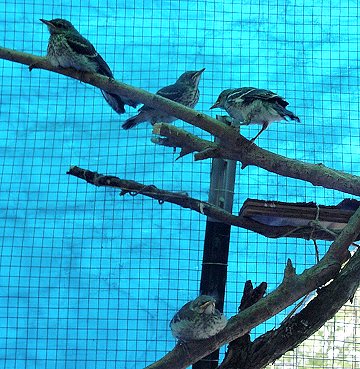 |
| Mockingbird Orphan Released May 2nd | 5 Mockingbirds in the outside enclosure Released May 2nd |
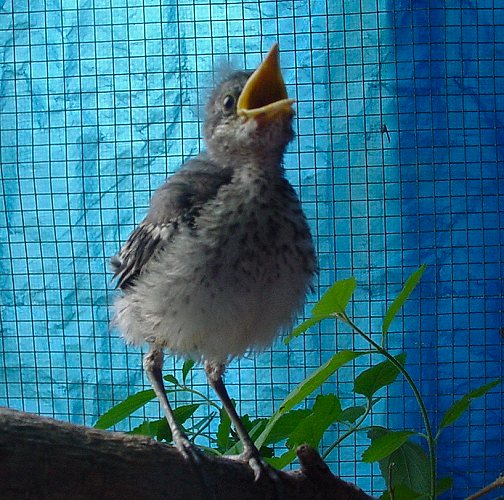 | 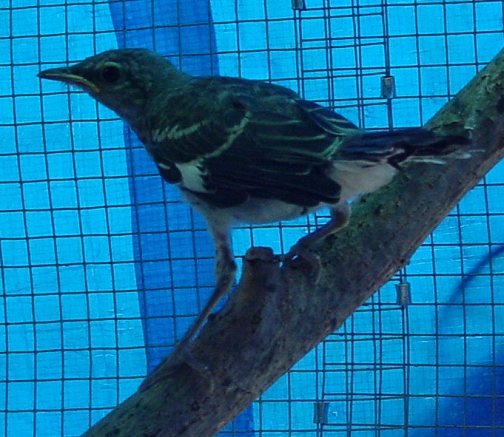 |
| Mockingbird Orphan Released May 21st | Mockingbird Juvenile Released May 10th |
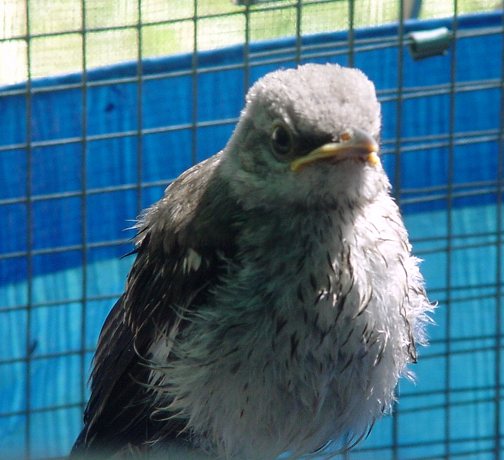 | 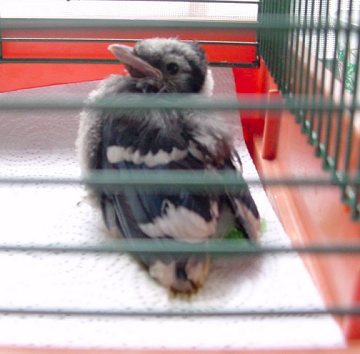 |
| Mockingbird Orphan | Injured Blue Jay |
Common Myths and Facts about Birds:
Fact: Although some birds do eat worms, best example the American Robin, most birds cannot handle the parasites associated with them.
Myth: Baby birds that have been touched by humans will be abandoned by their parents
Fact: As far as songbirds are concerned, they have a very poor sense of smell and will return to young as soon as we humans leave them be.
Myth: Give baby birds water so they don't get dehydrated
Fact: Never give a baby bird water alone as they cannot close their airway to allow it to pass into their crops. They drown easily and their air sacks are very susceptible to bacterial infections.
Moisten bread for a temporary solution, pieces of fruit or mix a baby bird mash into a paste with water and place it in the crop with a 1cc syringe, without the needle. They will gape for vibration or peeping sounds. Insert the syringe in past the windpipe and inject it slowly into the crop. If any backs up into the throat, clear it with a Q-Tip. The windpipe is the hole directly behind their tongue.
Myth: Birds imprinted on humans should never be released
Fact: A bird that has imprinted on people is at a definite disadvantage for the first few weeks of freedom. Any that outlast these weeks have as good a chance as any other. You still have to supplement the diet of a freed bird at regular intervals through the day, they will learn to forage and will imprint on it's own kind in time.
Myth: My cat brought us a bird, but I rescued it and it is fine
Fact: Many times a bird that has suffered a cat or other animal attack appears fine at first but dies within 24 hours of the attack. This is usually due to a bacterial infection caused by the animal's saliva. Birds may be in great condition a day after an attack, only to die an hour later.
Jun 2, 2005
Opossums
Opossums
Virginia Opossums (Didelphis virginiana) inhabit the United States east of the Rocky Mountains, Central America, and Pacific coastal North America. The Virginia Opossum is the only marsupial found in the North America. In South America and Australia there are about 80 species of Opossums. Opossums lived during the era of dinosaurs - fossil remains have been found from 70 million years ago.
 |
| Picture courtesy of Beartracker's Animal Tracks Den Kim A. Cabrera |
Opossums - Taxonomy
- Class: mammalia
- Order: didelphimorphia
- Suborder: marsupials
- Family: didelphinae (Opossum)
- Genus: didelphis
- Species: didelphis virginiana.
Opossums - Reproduction
The breeding season for Opossums begins in December and may continue through October with most of the infants born between February and June. Like all marsupials, Opossum females have a well-developed pouch. They produce an average of 7 young, once or twice a year (litters of 17 kids have been reported). At birth, the infants are hairless, embryonic-looking, and weigh about 0.1 grams because the period of gestation is 12-13 days and because they are born at a very early stage in their development.Young Opossums have to make a long and difficult journey from the birth canal into the pouch and latch onto a teat. The mother helps by licking the hair leading into the pouch. There are only 13 teats in the pouch and not all may be functional, so the excess infants will not survive. The young open the eyes at around 60-70 days and are weaned at about 100 days of age. Then they are often carried as they cling onto the mother's back. After separation from the mother, littermates may share common dens for some time. Very few young Opossums survive to become adults.
May 27, 2005
Rainbow Wildlife Rescue in Stephenville, Texas, specializing in birds and small urban wildlife
Urgently needed:
electric heating pads
freezer
material for building flight cages and enclosures, such as boards, plywood, mesh, screens.
Wishlist
Garden Hoses
Flea & Tick Treatments
Rabbit Hutches
Parrot Food
Sprinklers
Rubbing Alcohol
Storage Sheds
Wild Rice
Fence Panels
Frozen Beef, Chicken/Turkey, uncooked, unspiced
Baby Scale
Frozen Venison
Full Spectrum UV Lights
Dry Cat and Dog Food
Mulch, Woodchips, Woodshavings, Bedding
Canned Cat and Dog Food
Scoopable Cat litter
Rabbit Pellets
Rolls of mesh and chicken wire
Towles, Blankets, Rags
Tents at least 7 feet tall (broken ok)
Rugs and Carpet
Tarps and Netting and Screens
Building Material
Artificial green Turf
Lumber
Artificial Plants/leaves/flowers, trees
Printing Paper
Kennels and Pens (indoors and outdoors)
Ink Jet Paper, glossy
Heating Pads
Large Paper Clips
Heating Lamps
Black (HP 56) and Color Print (HP 57) Cartridges
Incubators
Laundry Detergent
Cages, Tanks, Live-Traps
Dishwashing Liquid
Bleach
Bottles/nipples
Sponges
Heavy Bowls
Bottle Brushes
Cuttlebone
Window Cleaner
Animal Vitamins
Paper Towels
Wheatgerm
Tissue Paper
Gerber Mixed Baby Cereal
Rubber Gloves (small)
Electrolyte Drinks (no flavor)
Brooms and Dustpans
Bird Treats
Large Plastic Storage Containers (With lids)
